Cheeseburger Casserole with Pickles and Cheddar
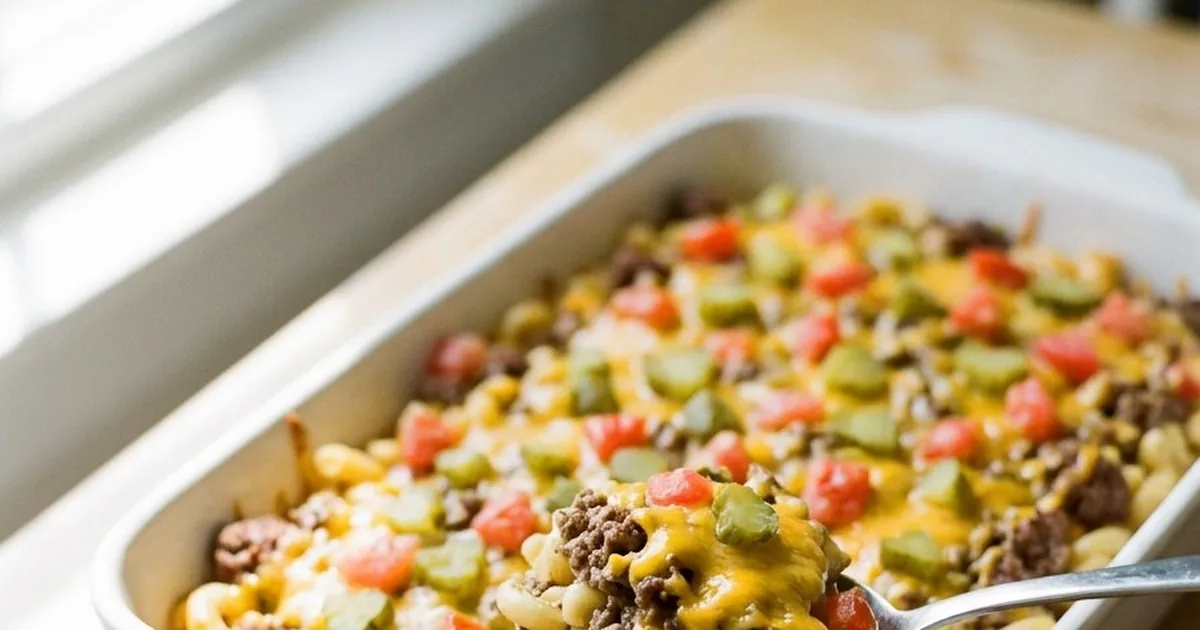
Cheeseburger casserole bakes beef mince, macaroni and a tomato-mustard sauce under melted cheddar, finished with pickles and fresh tomato. Ready in 45 minutes.
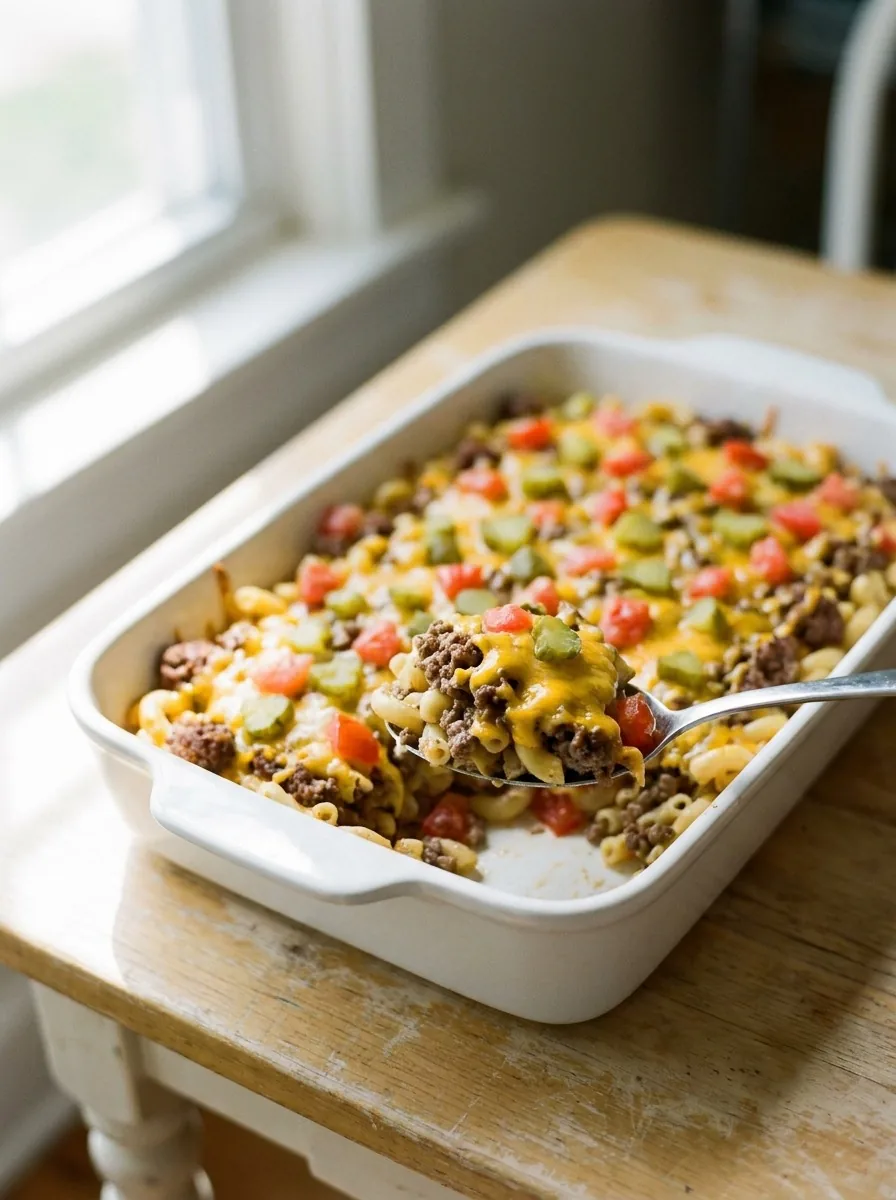
A cheeseburger casserole takes everything that works about a burger and puts it in a baking dish. Beef mince browns with onion, macaroni cooks in a tomato and mustard sauce, and the whole lot goes under a thick layer of cheddar until it bubbles at the edges. The pickles and chopped tomato go on afterwards, raw and cold, which is what stops the dish tasting like plain mince and pasta. It feeds six, it takes about forty-five minutes, and it uses one pan and one dish.
| Prep Time | 15 | Cook Time | 30 |
| Servings | 6 | Calories | 585 kcal |
Ingredients
- 700 g (1.5 lb) beef mince, 15 to 20% fat
- 300 g (10.5 oz) dried macaroni
- 1 large onion (about 200 g / 7 oz), finely chopped
- 3 garlic cloves, crushed
- 1 tablespoon neutral oil
- 400 g (14 oz) tin chopped tomatoes
- 3 tablespoons tomato purée (tomato paste)
- 2 tablespoons American yellow mustard
- 1 tablespoon Worcestershire sauce
- 2 teaspoons smoked paprika
- 250 ml (1 cup) beef stock
- 250 g (9 oz) mature cheddar, coarsely grated
- 100 g (3.5 oz) dill pickles, sliced into rounds
- 2 medium tomatoes (about 250 g / 9 oz), deseeded and diced
- 1 teaspoon fine salt, plus more for the pasta water
- Black pepper, to taste
Buy mince with some fat in it. Anything leaner than 15% browns poorly and goes crumbly and dry in the oven, and the handful of fat you spoon off halfway through is easier to control than the dryness you cannot fix.
The three sharp ingredients do the real work here: yellow mustard, Worcestershire sauce and dill pickles. Together they stand in for everything that normally sits in a burger bun, and if you leave any of them out the dish slides towards an ordinary pasta bake.
Essential Kitchen Tools
| Wide frying pan or saute pan (28 cm) | Browning the mince in a single layer |
| Baking dish (2.5 to 3 litres) | Holding the pasta at an even depth |
| Large pan and colander | Boiling and draining the macaroni |
| Box grater | Grating cheddar that melts smoothly |
| Wooden spoon | Breaking up mince and scraping the pan base |
A cast-iron pan that goes from hob to oven lets you cook and bake in the same vessel, which saves washing up but gives you a slightly deeper layer and five extra minutes in the oven.
Why This Recipe Works
A burger is a balance of three things: fat, acid and salt. Most casseroles built on mince and pasta get the fat and salt right and then forget the acid entirely, which is why they taste flat halfway through a plate. Here the mustard, the Worcestershire sauce and the pickle brine run through the sauce, and the pickles themselves land on top at the end, cold and uncooked.
Temperature contrast matters as much as flavour. Everything underneath the cheese comes out of the oven at around 90 °C; the pickles and chopped tomato are at fridge temperature. That gap resets your palate between mouthfuls and makes the sixth forkful taste as good as the first.
Undercooking the pasta is the other structural decision. Macaroni that is still firm when it goes into the dish absorbs sauce in the oven, which thickens the sauce and seasons the pasta at the same time. Fully cooked pasta can only take on water, so it bloats and the sauce stays loose around it.
Pro Tips for Better Results
Brown the mince in two batches if your pan is small. Crowded meat releases liquid faster than the pan can evaporate it, and from that point it boils rather than browns.
Deseed the fresh tomatoes. The seeds and jelly carry most of the water. Without them the topping stays bright and does not run across the cheese.
Pat the pickle slices dry. Thirty seconds with kitchen paper stops brine soaking into the cheese and turning the top layer soggy.
Grate the cheddar yourself. Bagged grated cheese is dusted with potato starch or cellulose to stop it clumping, and that coating prevents a clean melt.
Season the pasta water properly. It should taste like a weak broth. This is the only chance the pasta itself gets to be seasoned from the inside.
Rest it for ten minutes. Straight from the oven the sauce is too thin to hold a portion together; ten minutes and it sets enough to lift out in squares.
Nutrition Facts (per serving)
| Calories | Protein | Carbs | Fat | Fiber |
|---|---|---|---|---|
| 585 kcal | 38g | 45g | 28g | 4g |
Based on one of six servings with no side dish. Swapping to 5% fat mince and 180 g of cheddar brings a serving to roughly 470 kcal, with a noticeably drier result.